Guide
AI 101 for Travel Planning
What You Should Know Before You Ask AI

According to new research from Phocuswright, 56% of U.S. leisure travelers now use AI for at least one part of their trip planning. And it makes sense. These tools are fast, patient, and endlessly available. Ask them anything: what neighborhood to stay in, whether the train or the bus is better, what a seven-year-old will actually enjoy in Florence. They'll answer every question with the same calm confidence. That confidence is exactly where things get complicated. They're genuinely good at certain things. The problem is they're also genuinely bad at others, and they don't always distinguish between the two. In short, AI is a great travel assistant and a terrible travel advisor.
At Dewey, we build AI systems for experts and publishers - but we're also people with the same AI tools on our phones and the same urge to use them when planning our next trip. Understanding how these tools actually work is the secret to using them well. So let's get started.
AI 101: A Primer
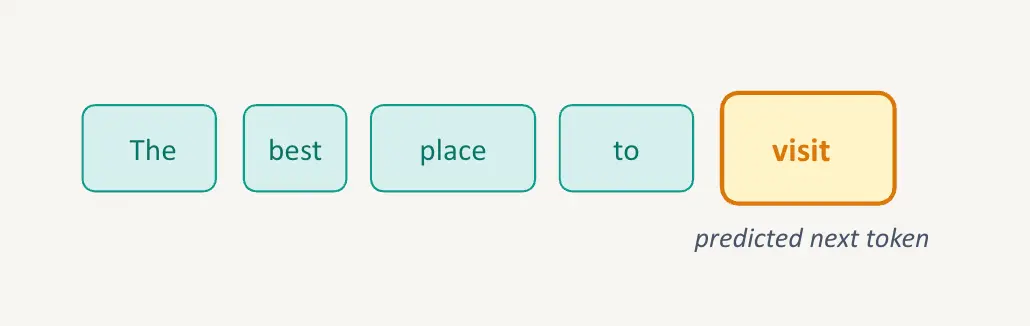
The AI tools you're using — ChatGPT, Claude, Gemini — are large language models, or LLMs. At their core, they're sophisticated prediction engines. They've been trained on enormous amounts of text from the internet and generate responses by predicting what word is most likely to come next, given everything that preceded it. That means they've ingested everything from all of Lonely Planet to travelogues from the 1970s to Reddit. They don't look things up the way you would, they don't verify, and they don't know what they don't know.
There are three broad ways an AI tool can access information. The first is parametric knowledge: everything baked in during training, with a clear cutoff date. The second is web lookup, increasingly the default mode: the model runs a search before answering your question, which means more up-to-date information and generally more dynamic answers. The third is RAG, or Retrieval-Augmented Generation, which you'll encounter in custom and enterprise-grade tools trained on a specific, curated set of documents - like what we've built for Untold Italy.

Samples of how Claude & ChatGPT show they are using web sources
No matter the training, these tools can all make mistakes and are only as good as the data they're built on.
What Should You Watch Out For?
There's a principle that holds across almost every good use of AI for travel: use it to expand your thinking and organize what you know, not to make the final call on anything you'd need to trust. With that in mind, here are the key risks - especially in travel, where the cost of being wrong ranges from a missed reservation to a ruined trip.
Accuracy
Travel information is among the most volatile that exists. A beloved trattoria closes, a hotel starts renovations, or a train strike radically changes routes. AI models are trained on data that may be months or years old — and when they answer your question, they don't always know the difference.
Hallucinations
The line between inaccurate and made-up is thin, but to you as a traveler, it frankly doesn't matter. Today's hallucinations are often very subtle, which makes them hard to spot. A slight shift in opening hours or age cutoffs sounds completely plausible - you only find out it was wrong by making the calls yourself. This is the core travel failure mode: not a dramatic hallucination, but a quiet fabrication presented with exactly the same confidence as everything else.
The information gap
Much of the best travel information doesn't exist on the internet, which means it won't make it into your AI answer. When we planned a ski trip in Italy, none of the ski schools had program details online. Booking required old-fashioned emails and phone calls. And think about the question "what neighborhood should I stay in?" in any city you know well. Your answer would depend entirely on who's asking and what kind of trip they're having. AI has the aggregated answer - the consensus from thousands of articles and forums - which is precisely what produces the same five neighborhoods in every result.
The overplanning trap
AI makes it seductively easy to fill every hour of your itinerary. You'd never plan a trip like that by hand, because it would be too labor-intensive. A jam-packed schedule removes much of the magic of travel - the ability to wander somewhere unexpected or take a friendly recommendation made over lunch.
Homogenization
With everyone using the same tools and drawing from the same training data, many travelers end up with roughly the same to-do list. The "hidden gems" AI recommends are only hidden in name, not from the other ten thousand people who got the same suggestion. If distinctiveness matters to how you travel, be aware that AI optimizes for the popular answer.
Where AI Shines For Travel
Brainstorming and expanding your aperture
"What are we missing?" is a question AI answers well, especially early in the planning process, when you're still figuring out what's possible. It's particularly good at surfacing the questions you didn't know to ask: what's the right season, what's the realistic budget range, what do families with young kids typically underestimate about this kind of trip.
Use it to expand your thinking early; don't use it to finalize anything.
Organizing overwhelming information
Once you have the information - such as a complex flight itinerary, a set of overlapping events, a long list of options to compare - AI is excellent at imposing structure. Feed it complexity and ask it to make sense of it: model budget scenarios, sort options by your stated priorities, build a day-by-day framework from a pile of loose inputs.
Real-time problem solving
When plans fall apart on the ground, AI can be a useful companion for figuring out a backup plan. It might not be perfect, but you're already there, with boots on the ground, so you can verify ideas quickly.
Proceed With Caution
Every trip has components that need to fit together just right: a complex connecting flight, an international car rental, a booking window that closes. In those moments, where the margin for error is thin, be extra careful.
These are also the moments when a friend who has been there or a travel specialist can really shine. They narrow the options with real opinions, catch the details you'd never think to ask about, and solve logistics problems elegantly. A planner we worked with recently recommended one tiny tweak: pick up the rental car at the airport mid-trip, drive to the mountains, and return directly at the end. That meant less backtracking with a car full of kids. That's the kind of detail that doesn't come from the internet. It comes from someone who has thought hard about what actually goes wrong.
Practical Guidance
Use a paid plan.
At around $20/month for both ChatGPT Plus and Claude Pro as of spring 2026, a paid plan gives you access to better models, more features, and meaningful privacy controls. For travel planning — which often involves personal details about your family, finances, and schedule — that's worth it. But remember to opt out of your data being used for training; it defaults to on.
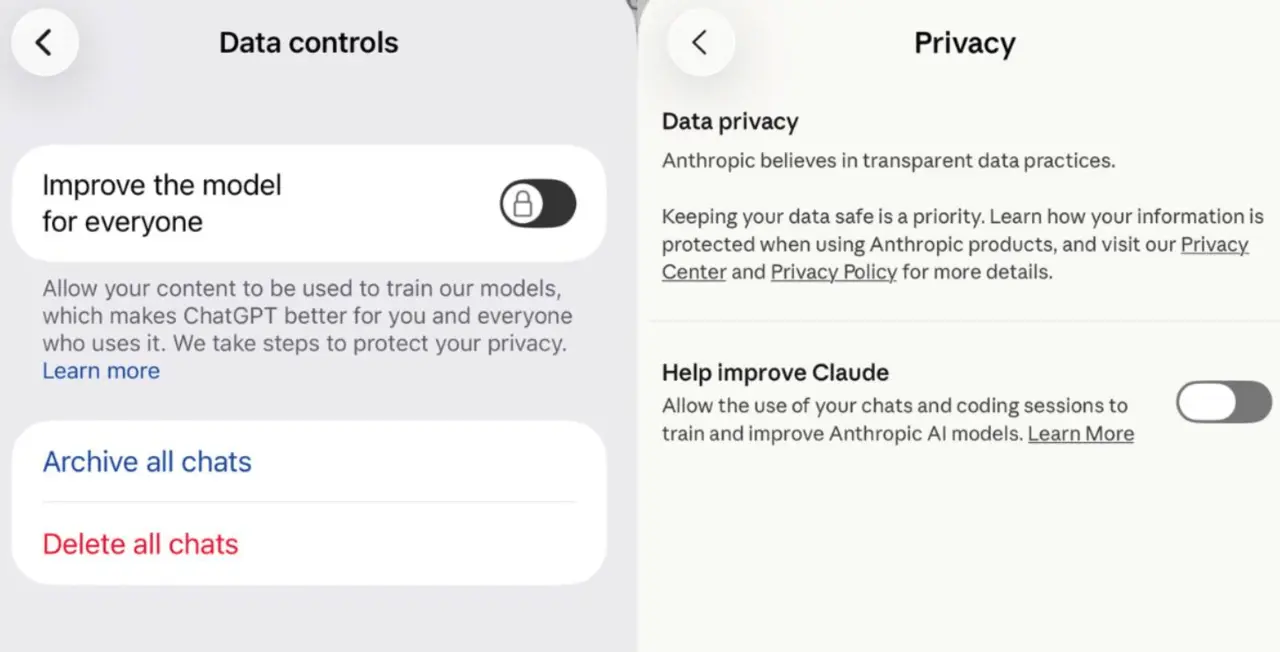
Privacy options for ChatGPT & Claude
Build a project and give it your context upfront.
Both Claude and ChatGPT support persistent "projects" where you can share core background details. Set it up at the start: who's traveling, ages, mobility considerations, budget, things you love and hate, key dates. Every subsequent conversation builds on that foundation instead of starting from scratch. It's the single most practical thing you can do to get better, more personalized output.
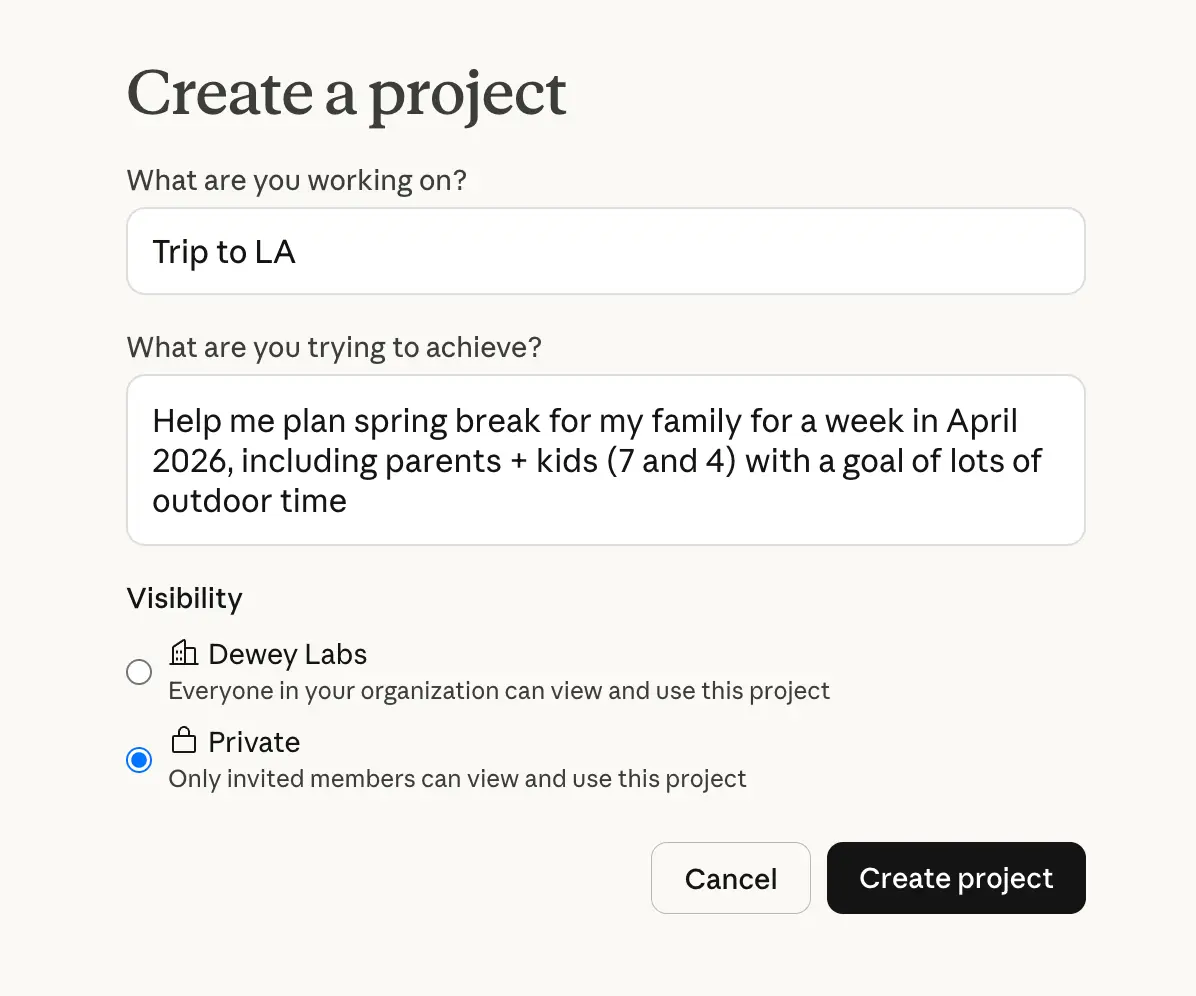
Example of a project setup in Claude
Push back on the first answer.
The first response is a draft, not a recommendation. Ask what it might be missing, or ask it to surface the assumptions it made. These follow-up questions consistently produce better information and expose gaps in the initial answer.
Ask it what questions you should be asking.
This is particularly useful early in planning an unfamiliar destination. "What should I be thinking about for a family ski trip to Italy with young kids?" will often produce a useful checklist of considerations you hadn't thought of — not because AI knows the answers, but because it's good at generating the right questions.
Cross-check anything critical against primary sources.
Visa requirements, entry documentation, train or ferry schedules, age restrictions, booking windows — verify all of it at the source. AI presents outdated information with the same confidence as current information, and in travel, outdated can mean stranded.
AI won't replace a great travel advisor. And for most trips — especially complex ones, unfamiliar destinations, or anything involving logistics that have to work — you don't want it to.
What it can do is make you a better planner: more organized, more informed, better prepared with the right questions before you talk to the expert who has actually been there. Use it to start the trip. Use humans to make it great.