Case Study
How the Association for Academic Leaders ensures resources meet evolving member needs
August 2026
The Challenge
The Association for Academic Leaders is one of the most trusted voices in independent school education. At the time they partnered with Dewey in 2024, generative AI was brand new to most of their members, and the goal was exactly right for the moment — give Academic Leaders a safe, guided way to tap the Association's own body of expertise. The stakes were high: they knew they needed to model the responsible AI adoption they teach their members.
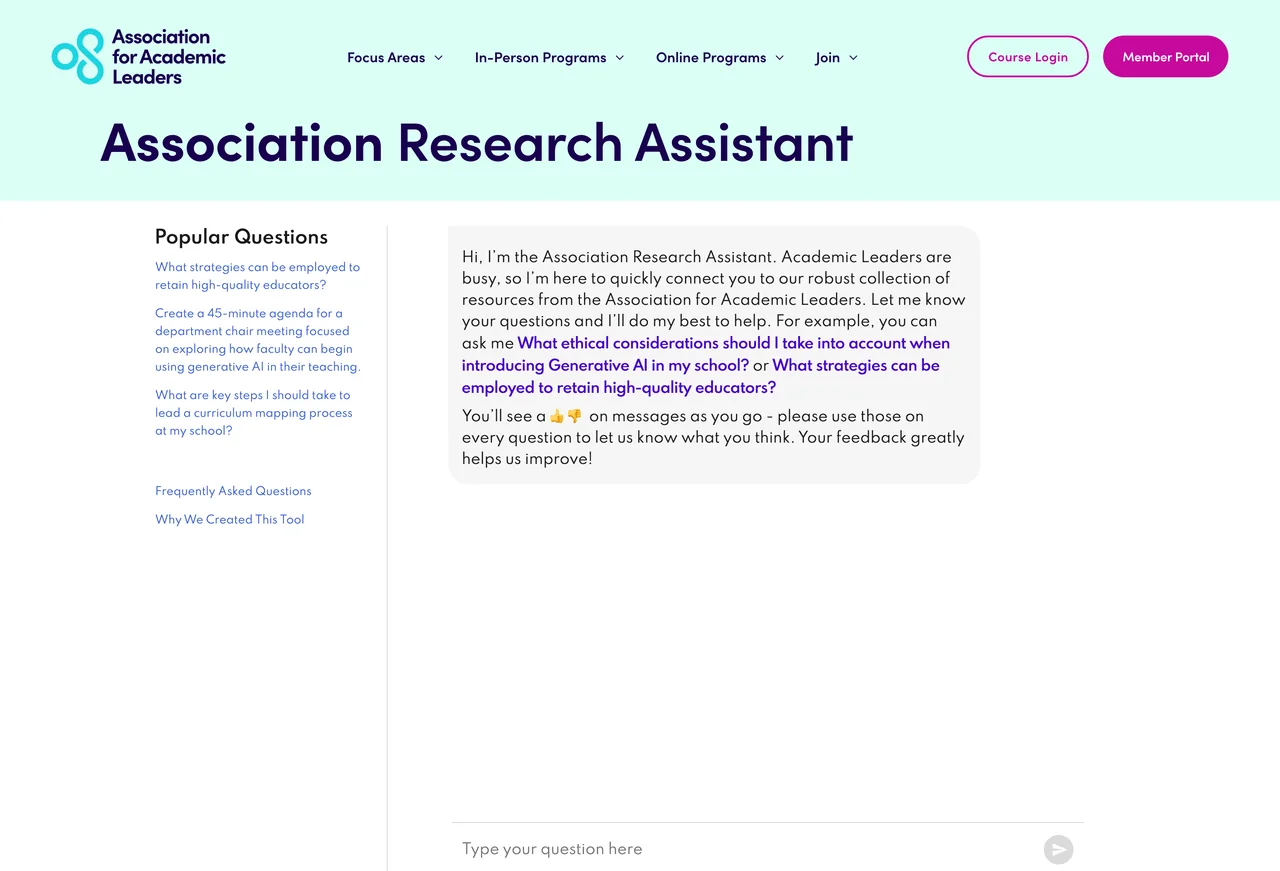
The result is the Association Research Assistant, an AI tool that draws only on the Association's own body of work to point Academic Leaders to the most relevant resources for their questions, in seconds.
“When we launched our tool in 2024, many of our members were just beginning to navigate the possibilities of generative AI. We wanted to provide them with a safe, practical way to start using the technology. Partnering with Dewey allowed us to introduce an AI-driven experience designed specifically to connect our members directly with our resources — resources they knew and trusted.”
The Association's first version of the tool built a strong foundation for a natural evolution as members started using AI more actively. Today, many use Claude, Gemini, or ChatGPT every day. But these general-purpose models have a blind spot — they do not know independent schools. Ask a mainstream AI assistant how to map a curriculum, and it reaches for district standards and generic best practices. Independent schools don't run on district standards; each is defined by its own mission and values, and that is exactly what a general tool can't account for.
With that in mind, it was time to change the goal for the Association Research Assistant. It was no longer simply about helping members find content, but about helping members do their hardest work in the age of AI, with specialized guidance from the Association's resources.
The Solution
The Association turned to Dewey as a trusted partner to help bridge the evolution. Now the Association Research Assistant serves a wider range of needs. It can still point an Academic Leader at a relevant webinar or resource, which continues to unlock the vast library available to members. But it can also help them build whatever it is they're working on — a curriculum map, an AI-resilient assessment, or the structure of a faculty workshop. Constraints written for a narrower 2024 tool are coming off, and we're training the tool on real-life examples of the work members want help with, drawn directly from the Association's own courses and workshops.
What makes that possible is the unique context general models do not have access to. The tool draws on two layers at once: the Association's own expertise, and the worldview of independent schools. Where a mainstream AI assistant defaults to district standards, this one centers a school's mission and core values.
The new version will meet members where they already are and shape the experience specifically to them. The same knowledge base can power a quick, factual helper for one member looking for logistical information, and a hands-on collaborator for another planning a faculty workshop.
Finds the answer.
Points members to the exact webinar, course, or resource that speaks to their question — grounded only in the Association's own work.
Does the work.
Builds alongside them — curriculum maps, AI-resilient assessments, faculty workshop structures — centered on each school's mission.
The Impact
The first iteration of the tool has been live and in members' hands since 2024, answering questions entirely from the Association's own body of work rather than the open web, with a 93% answer rate. When the Association Research Assistant doesn't have a grounded, reliable answer, it says so, rather than responding with generic internet knowledge.
That grounding is what makes it trustworthy, and it's why the people who know the material best have made it part of how they operate. The Association's own internal team uses the tool in its demos, putting it to work live in front of prospective member schools to demonstrate the breadth of resources available. Every member interaction is also a signal, showing the Association exactly what members want the tool to handle next.
What's Next
The Dewey team continues to expand the tool's capabilities from a retrieval helper into a broader collaborator, tuned with real examples of the tasks members most want help with — from planning a workshop to mapping a curriculum.
Up next, the ambition is bigger still: to let members use the Association's expertise inside the tools and systems they already work in, plugging its knowledge directly into whatever general AI assistant a member uses, so trusted, mission-centered context follows them into their own workflows.
The throughline is simple — make the Association's expertise not just findable, but usable, in the moment and in the tools members already reach for. It's a shift from a resource to a partner, built specifically for the people the Association has always served.
Want to build your own?
Connect with us to see how Dewey helps organizations turn trusted expertise into everyday tools.
Book a Consult