Essay
How to Break Through the AI Adoption Plateau

Search behavior has changed with access to AI assistants, which is affecting how people engage with your content. I recently wrote about what AI is changing for mission-driven orgs, and how they can adapt. Now it’s time to talk about the other side of the shift: team-wide AI adoption.
This is the organizational change that lets your staff do things in minutes that used to take a specialist a full day. Leaders see the value, but often struggle to make progress when it comes to incorporating AI into their day-to-day work.
The AI adoption ladder
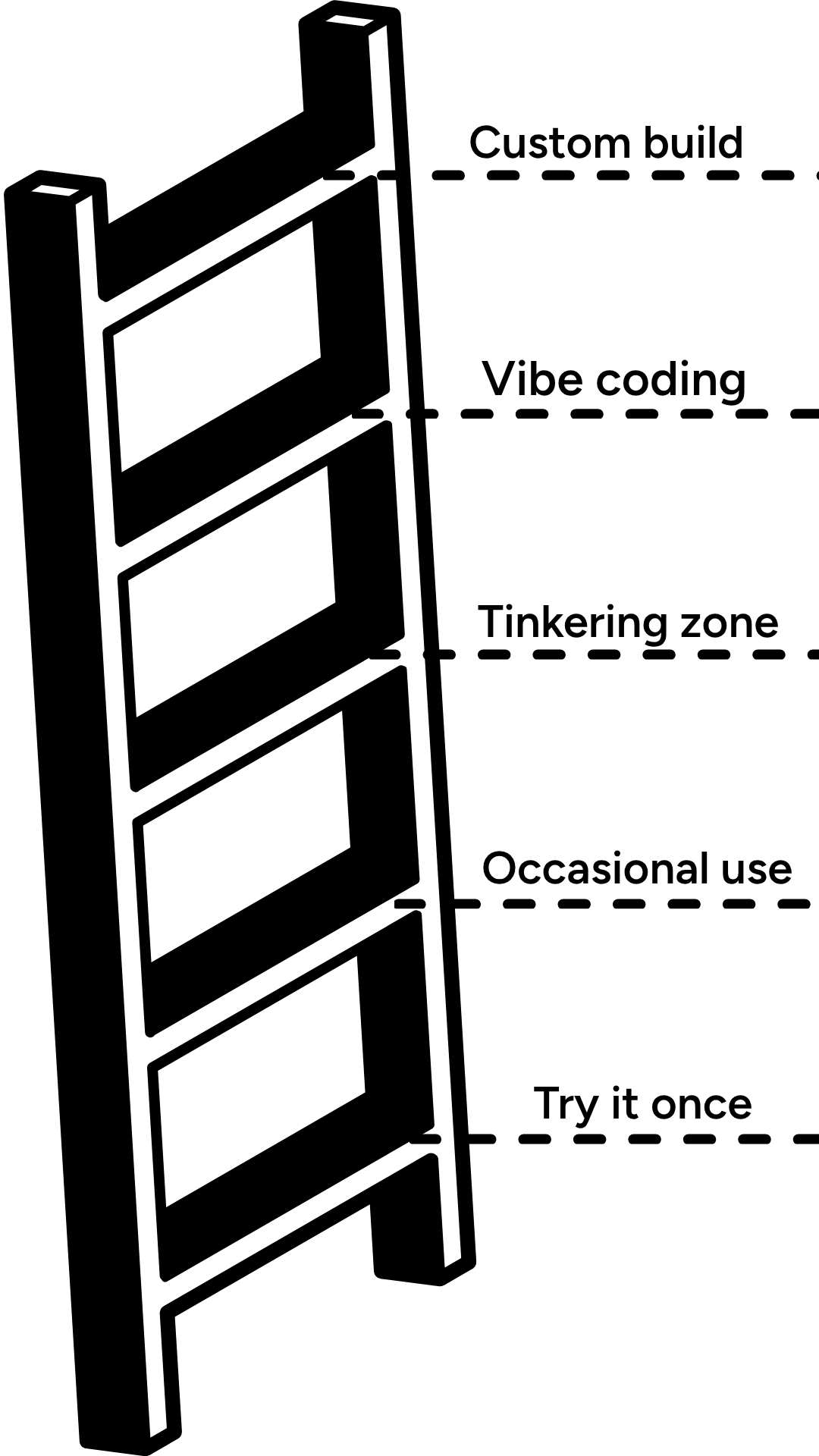
A useful framework for thinking about this is a ladder with five rungs, running from the person who has barely touched an AI tool to the team that has integrated it deeply into how they work. Most people sit on the first or second rung.
The AI adoption ladder
The first rung is trying a tool once or twice, getting a first impression, and forming an opinion based on that experience. The second is occasional use for small tasks like drafting an email or brainstorming a headline. This second rung is where most teams quietly get stuck, because occasional use feels like enough. You've technically tried AI, you've had a few good results, but you haven't spent enough sustained time with the tool to know where it's brilliant and where it falls apart. When a real question comes up about whether AI would help or hurt on a specific project, you don't have the intuition to answer.
The rung above that is the one worth aiming for.
The tinkering zone
The third rung is the tinkering zone: regular, deliberate use for real work, where the tool sometimes surprises you and sometimes fails in illuminating ways. Both are teaching you something, and over time those experiences accumulate into intuition you can rely on. This is where you start to know, without having to think about it, whether a given task is a good fit for AI or not.
These four steps will get you there:
Pick one tool and commit to it. ChatGPT, Claude, Gemini, it genuinely doesn't matter which. What matters is going deep with one rather than shallow with three. These tools get better the more context you give them, and that compounding only happens with sustained use of a single tool. For leaders, choose one tool that your company or organization will use - this will enable better sharing and make it easier to align on best practices.
Pay for a tier and toggle off the training setting. This gets you a better model and opts your data out of being used to train future versions. In ChatGPT, go to Settings, then Data Controls, and toggle off "Improve the model for everyone." In Claude, go to Settings, then Privacy, and toggle off "Help improve Claude." One important nuance: paying doesn't automatically protect your data. The real privacy line is consumer versus enterprise, not free versus paid. If you're handling constituent data or sensitive program information, know the difference.
Turn on connectors where appropriate. These tools can connect to your calendar, email, documents, and Slack. The more context the tool has about your actual work, the more useful it becomes. Start with the connectors that would remove friction from your daily work, not the ones that touch the most sensitive data.
Take the 30-day challenge. Use your chosen tool every day for 30 days on real work - not demos, not toy problems, but the actual tasks you wish you didn't have to do. At the end of those 30 days, you'll know more about what AI can do for your organization than any webinar can teach you.
Vibe coding
Once fluent in the tool of your choice, the fourth rung opens up something that reshapes what's possible for teams without engineering resources: you can build working software by describing what you want in plain language. The shorthand for this is "vibe coding," and it lands well in three places. Prototyping an idea, where a clickable demo will get better feedback from stakeholders than a slide deck. Analyzing data at scale, where work that used to require a Python notebook and a data scientist is now a conversation. And building simple, standalone tools like a sign-up form that feeds a Google Sheet or an internal calculator for program eligibility.
To make this concrete, here’s an example of something I vibe coded for myself. When I was training for the Brooklyn Half Marathon, I used Claude Code to build a training app. After about an hour, I had described what I wanted in plain language, connected it to my Strava and Google Calendar accounts, and deployed it to the web for free - all without an engineering background. That project taught me how calendar integrations work, what APIs actually are, and how data flows between different tools, and those skills have directly informed product decisions I've made at Dewey since.
Where the line is
The fifth and final rung is when you bring in engineers and partners to build something production‑grade. Knowing when you’ve crossed into that territory is one of the most important judgments a mission‑driven leader can develop about AI. There is a real gap between something you can vibe code in an afternoon and something ready for actual use with the people you serve. Vibe coding is powerful for prototypes, internal tools, and personal projects, but the moment you are touching constituent data, taking payments, handling authentication, or building anything that has to stay up reliably, you have crossed into territory that requires real engineering expertise. Handling personally identifiable information, integrating with payment systems the way regulations require, maintaining uptime, meeting accessibility standards, and putting in place the security posture that protects the vulnerable populations you serve are all real disciplines, and they do not become optional just because the code got easier to write.
The value of vibe coding for your team isn't that you become an engineer or a replacement for one. It's that you become a much better buyer and collaborator, because you now have a working understanding of where the easy parts end and the hard parts begin.
Where to start
If you take one thing from this, take the 30-day challenge. Pick a tool tonight, set it up, and use it every day for a month on work you care about. Add a daily reminder in your calendar if it helps hold you accountable. The intuition you build in those 30 days is what makes every other AI conversation at your organization go better.
If you want to learn more about AI’s impact, I share my thoughts in this article on What AI is Changing for Mission-Driven Orgs, and I spoke on the topic with Jenn Johnson of Forum One, a digital agency for nonprofits, government organizations, and other mission-driven teams, which was recorded here.
If you’re navigating any of this with your team, I’d love to hear what challenges are coming up. I save time every week for free consultations, so you can get in touch anytime.