Essay
What AI is Changing for Mission-Driven Orgs (And Why It Matters)
Practical AI for Mission-Driven Organizations: April Webinar Recap

I had the privilege of joining Jenn Johnson of Forum One for a recent webinar on what AI is changing for mission-driven organizations and what this means in practice for nonprofits, foundations, and government agencies. The takeaway: the shift to natural language in search queries is a mission problem for these organizations, not just a tech upgrade. It's showing up in two places at once, in how your audience finds information and in how your staff gets work done. The orgs that treat both seriously are the ones that will keep reaching their communities.
That framing comes from the work we do at Dewey. We build natural language interfaces for organizations whose content really matters: public health publishers, investigative newsrooms, parenting experts, education nonprofits. We bring what's possible with AI to the work mission-driven teams are trying to do.
How search behavior has changed
Search used to mean typing a keyword or two, scanning a list of results, and clicking until you found your answer. Now you can just say what you need in plain language.
How did we get here? ChatGPT launched in November 2022, and within two months it had 100 million users. Today it has 900 million weekly active users, more than the combined populations of the US, the EU, and Canada. People got comfortable asking full questions and getting direct answers, and that changed expectations fast.
Google responded. In May 2024, they launched AI Overviews, the AI-generated summaries at the top of search results. BrightEdge, a leading enterprise search engine optimization and content performance platform, tracked it over a full year: AI Overviews now trigger on nearly half of all queries, up 58% year over year, and the distribution isn't even. AI Overviews on education searches jumped from 18% to 83%, and healthcare searches hit 88%.
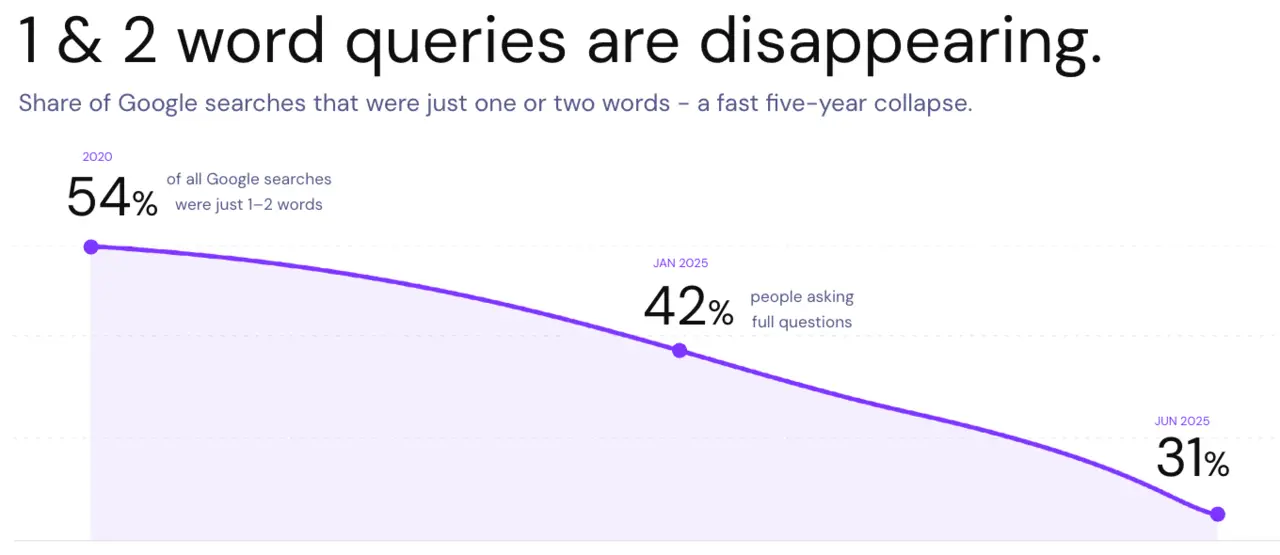
The shift in user behavior is just as steep. In 2020, more than half of all Google searches were one or two words. By January 2025, that had dropped to 42%, and by June 2025 it was 31%. Meanwhile, on ChatGPT, the average prompt is 23 words. People are learning to ask questions in full sentences instead of typing keywords, and those longer queries (8 words and up) are 7x more likely to trigger an AI Overview, which means they're far more likely to land in an AI-generated answer than to send someone clicking through to your site.
What this looks like in practice: someone researching education policy used to type "benefits of recess." Now they type "what is the impact on test scores when kids have more or less recess time?" Same topic, completely different query: specific, conversational, intent-laden. It requires a fundamentally different kind of answer.
You don't even have to be a ChatGPT user for this shift to apply to you. Google has changed search for everyone. Whether or not your audience has tried an AI tool, they are already searching differently because of the AI tools that have changed Google itself.
Why this is a mission problem, not a tech problem
When a parent searches "how do I apply for SNAP benefits in my county," they used to get a list of pages, some relevant and some not, and they had to do the work of clicking through, scanning, and connecting the dots. Today, an answer engine tries to give them everything in one shot: an explanation of the process, a link to their county portal, the specific eligibility criteria, and the documents they'll need.
This is what's called braided intent: informational, navigational, and transactional needs collapsed into one query. For a county social services office, the question isn't "is your content showing up?" It's whether your content is structured well enough that an AI can pull the right answer from it and route the parent to the right place. If it isn't, the parent doesn't email to complain, they just give up. The mission of getting people the help and resources they're entitled to quietly fails.
For a humanitarian organization, the equivalent is someone asking AI what's happening in a crisis area, and your reporting either being cited or not. For a public health publisher, it's someone asking about a treatment and your evidence-based content either showing up or being replaced by a forum post. For an education nonprofit, it's a school board member asking about evidence on instructional time and your research either being available or invisible.
The current data is sobering. 60% of traditional searches now end without a click. When AI Overviews are present, that jumps to 83%, and in Google's AI Mode it's 93%. So even if your content ranks well in the old model, fewer people are reaching it. The traffic isn't disappearing because of tech failure: it's redirecting because of a behavior shift, and your content needs to meet that.
What we built for County Health Rankings
The clearest example of this in practice is something we built with Forum One and the University of Wisconsin's County Health Rankings. They run What Works for Health, a database of evidence-based strategies for improving community health. Deep, authoritative content. The kind of resource people genuinely need, and the kind that's hard to find through traditional search if you don't already know the right terminology.
The old experience was: keyword search, filter by topic, scan a list of strategies, click into each one, skim. It worked, but it required users to already know what they were looking for. People came in with specific questions like "what evidence-based strategies help rural communities address maternal health?" and the search interface couldn't meet them there.
Forum One and Dewey built Evi, a natural language interface trained on the full What Works for Health content library, including internal methodologies and related sections. Instead of keyword matching, users ask questions in their own words. The system answers from their content, not the open internet, and cites sources from within the library so users can verify and dig deeper.
What I want to flag for mission-driven readers is what makes this different from generic AI tools.
It's controlled. The system was trained only on their content. It won't make up an answer or pull from a forum post, and when the right answer isn't in the library, it says so.
It's grounded in their authority. Every answer cites the specific underlying source. The answer engine doesn't replace their expertise; it surfaces it.
It teaches the team about their own audience. Once Evi was live, the user data told us things the team couldn't see before. The site's navigation had a section for Clinical Care, but the user data showed Mental Health was one of the largest single areas of interest, worthy of top-level navigation. Equity framing kept showing up across categories, supporting deeper work the team was already committed to. That's actionable intelligence about the community they serve, not just a search interface.
This is the model for mission-driven content in the AI era. Not "replace experts with AI," and not "chase the algorithm." Make actual expertise findable in the way people now expect to find things.
What this means for your content
You don't need to build an Evi tomorrow. The earlier-stage move, and the one most mission-driven teams should start with, is making sure the content you already have is findable in the new model. That work happens in three layers: the questions your audience is actually asking, the authority your content demonstrates, and the structure that makes it readable to AI.
Start with the questions. Generate the top 50 to 100 your audience actually has when they come to your organization, not the questions you want them to ask, but what they're actually coming with. Pull from your support inbox, your donor calls, your contact form, your Google Search Console, and tools like AnswerThePublic or AlsoAsked that show what people search for in your space. Then run those questions through ChatGPT, Claude, Perplexity, and Google AI Overviews, or through a monitoring tool like Peec.ai, Peekaboo, or Promptwatch, to see whether your content shows up.
These tools will give you a roadmap of what content you might need to develop or ways you might want to increase the authority of your existing content to improve model accessibility.
The other side of the shift: freeing up staff time
The same change that's reshaping how your audience searches is reshaping how your staff can work. The skills that used to gatekeep certain kinds of work, like coding, data analysis, prototyping, and synthesizing across huge volumes of information, are now accessible to anyone who can describe what they want in plain language. For mission-driven teams that are perpetually short on capacity, this is the most underrated half of the AI shift.
I think about it in two buckets. The first is removing drudgery: important tasks that distract you from work that actually needs your judgment, like pulling action items out of every meeting. The second is doing things that just don't work at human scale, like analyzing a month of partner calls for trends no individual could spot. The information is already flowing through your organization in constituent calls, donor conversations, and community feedback. AI can help you actually hear it.
Getting there requires more than occasional use. Most people try ChatGPT or Claude once, or use it now and then to draft an email, and never build the intuition to know when AI is the right tool and when it isn't. The dangerous spot is the tinkering zone because you can get stuck there thinking you know what is possible. You want to push past this into regular use. Here are three steps to get you there. Pick one tool and commit to it: going deep with one beats shallow with three. Pay for a tier and toggle off the training setting so your data isn't used to improve future versions, and know that the real privacy line is consumer versus enterprise, not free versus paid. And turn on connectors where appropriate, so the tool has context about your actual work. Then commit to using it every day for 30 days on the tasks you wish you didn't have to do. You'll learn more in those 30 days than any webinar can teach you.
Once you're fluent in your tool of choice, the next rung up is experimenting with vibe coding. You can prototype an idea, where a clickable demo gets you better feedback than a slide deck. You could analyze data at scale, where work that used to require a Python notebook and a data scientist is now a conversation. You might build simple, standalone tools, like a sign-up form that feeds a Google Sheet or an internal calculator for program eligibility, that don't justify engineering time but would genuinely help your staff.
One important caveat. The gap between a working prototype and a production-ready tool is real, especially when constituent data, payments, or reliability are involved. Vibe coding is magic for MVPs, internal tools, and personal projects, but once you're touching sensitive systems, working with engineers and partners matters. The value isn't that you become an engineer; it's that you become a better buyer and collaborator.
Where to go from here
Once your team is fluent and the experiments are working, you'll want to think about what it looks like to bring these capabilities into your organization more durably. That might mean formalizing how your team uses AI, investing in EEAT and schema as an ongoing practice rather than a one-time fix, or building a controlled answer experience on your own properties (something like Evi) when your content depth justifies it and your audience is asking questions your existing site can't surface well. That's where Forum One and Dewey come in, and it's not the right move for every organization. It's the right move when you can clearly point to "we have deep content, our audience needs to ask questions of it, and the current site can't deliver that."
Mission-driven AI work isn't about chasing a trend. It's about meeting the people you serve where they actually are, which, increasingly, means meeting them inside an AI-mediated search experience. The orgs that do this well are the ones that treat their content like the strategic asset it is, structure it for the new model, and pick the right entry point for their team and budget.
If you're working through any of this for your team, we'd love to hear what you're up against. You can drop us a note any time.
To watch the full webinar, click here.